
 Get a Quote
 Send Inquiry
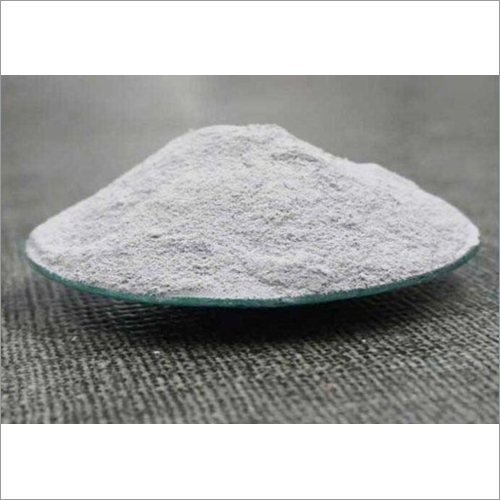
Micro silica
Price 15 INR/ Kilograms
MOQ : 10 Tonnes
Micro silica Specification
- Application
- Used as a pozzolanic material in concrete, construction, and refractory applications
- Surface Finish
- Finely powdered
- Usage & Applications
- High-performance concrete, shotcrete, refractory castables, oil well grouting
- Density
- 350 Gram per cubic centimeter(g/cm3)
- Purity(%)
- 8598%
- Melting Point
- About 1,710C
- Chemical Composition
- SiO2 ~ 90-96%, Minor elements
- Form
- Powder
- Water Absorption
- Low
- Hardness (%)
- Not applicable (powder)
- Types of Refractories
- Acidic Refractories
- Shape
- Amorphous, extremely fine spherical particles
- Porosity
- Reduces porosity of concrete
- Dimensional Stability
- High dimensional stability
- Strength
- Improves compressive strength of concrete
- Specific Gravity
- 2.2 2.3 g/cm
- Thermal Conductivity
- Low
- Color
- Gray to off-white
- Particle Size
- 0.1-0.3 m
- Pozzolanic Activity Index
- > 105% (compared to control)
- Packaging Type
- Bags or bulk
- Shelf Life
- Minimum 12 months in sealed packaging
- Moisture Content
- Typically < 1%
- Loss on Ignition (LOI)
- < 6%
- pH Value
- 6.5-7.5
- ISO/ASTM Standards
- Conforms to ASTM C1240, EN 13263
- Storage Conditions
- Store in a dry, well-ventilated area, away from moisture
Micro silica Trade Information
- Minimum Order Quantity
- 10 Tonnes
- Payment Terms
- Cash Advance (CA), Cash in Advance (CID), Cheque
- Sample Available
- Yes
- Main Export Market(s)
- Asia, Australia, Central America, South America, Eastern Europe, Western Europe, Africa
- Main Domestic Market
- All India
About Micro silica
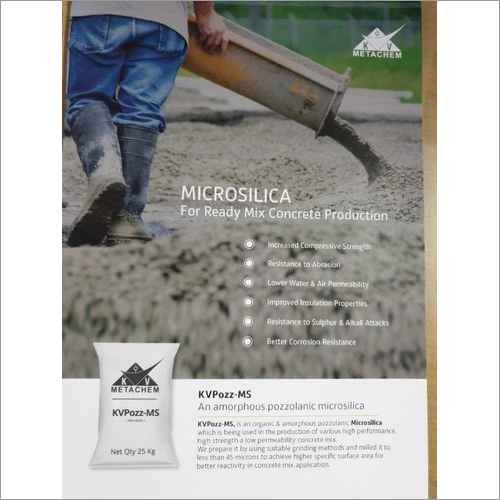
KVPozz-MS, is an organic & amorphous pozzolanic silica which is being used in the production of various high performance, high strength a low permeability concrete mixes. We prepare it by using suitable grinding methods and milled it to less than 45 microns to achieve higher specific surface area for better reactivity in concrete mix application.
ASTM C1240 Chemical composition & physical properties are maintained and tested according to the standards mentioned in ASTM C1240
Application:
KVPozz-MS is suitable for all concrete and applications where the benefits required such as high performance, increased durability & enhanced rheology.
Packing:
25 KG PP Bags
1000 KG Jumbo Bags
Micro silica significantly boosts the compressive strength and durability of concrete by acting as a pozzolanic material. Its ultra-fine, amorphous particles fill voids in the mix, reducing porosity and enhancing the overall integrity of concrete and refractory applications.
Quality That Meets Global Standards
Conforming to ASTM C1240 and EN 13263, our micro silica offers consistently high purity (8598%) and reliable performance. Produced under strict quality controls, it delivers excellent pozzolanic activity index (>105%) and minimal loss on ignition (<6%), catering to demanding construction projects.
Versatile Applications Across Industries
This product is suited for various applications such as high-performance concrete, shotcrete, refractory castables, and oil well grouting. Its low thermal conductivity and high dimensional stability make it ideal for both construction and refractory uses where longevity and resilience are critical.
FAQs of Micro silica:
Q: How is micro silica used in concrete applications?
A: Micro silica is added to concrete mixes to act as a pozzolanic material. Its fine, amorphous particles react with calcium hydroxide to form additional cementitious compounds, resulting in improved compressive strength, reduced porosity, and enhanced durability of the finished structure.Q: What benefits does micro silica provide in construction material?
A: The addition of micro silica to construction materials offers increased compressive strength, higher durability, improved dimensional stability, and lower water absorption. It also reduces voids and permeability, leading to longer-lasting and more resilient concrete and refractories.Q: Where should micro silica be stored to maintain its effectiveness?
A: Micro silica should be stored in a dry, well-ventilated area, away from moisture, and kept in sealed packaging. Proper storage preserves its quality and ensures a minimum shelf life of 12 months.Q: What is the typical process for incorporating micro silica into concrete?
A: Micro silica can be blended into concrete as a powder or slurry. It is usually added during the dry mixing stage, alongside other cementitious materials, ensuring even distribution for optimal pozzolanic reactions and improved mix properties.Q: When is it recommended to use micro silica in construction projects?
A: Micro silica is recommended when high-performance or high-strength concrete is required, such as in critical infrastructure, bridges, tunnels, shotcrete, and refractory linings. Its ability to reduce porosity and enhance longevity makes it ideal for demanding environments.Q: What safety or handling precautions should be observed with micro silica?
A: As a fine powder, micro silica should be handled with appropriate personal protective equipment, such as masks and gloves, to minimize dust inhalation and skin contact. Always follow local safety guidelines for material handling and storage.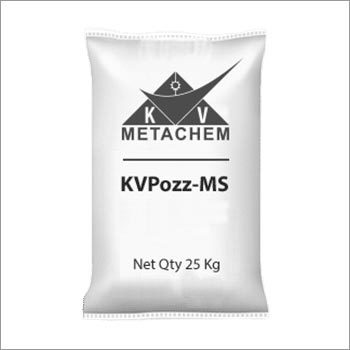
Tell us about your requirement

Price:
Quantity
Select Unit
- 50
- 100
- 200
- 250
- 500
- 1000+
Additional detail
Mobile number
Email

More Products in Microsilica Category
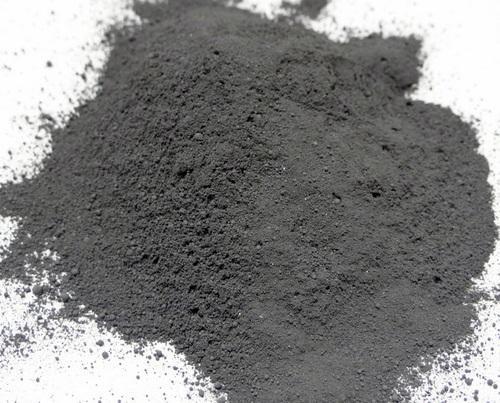
Micro Silica Powder
Price 10 INR / Kilograms
Minimum Order Quantity : 1 Ton
Dimensional Stability : Other, Excellent at High Temperatures
Specific Gravity : 2.2 2.3
Shape : Other, Amorphous Powder
Chemical Composition : SiO2 > 85%, with minor Al2O3, Fe2O3, CaO
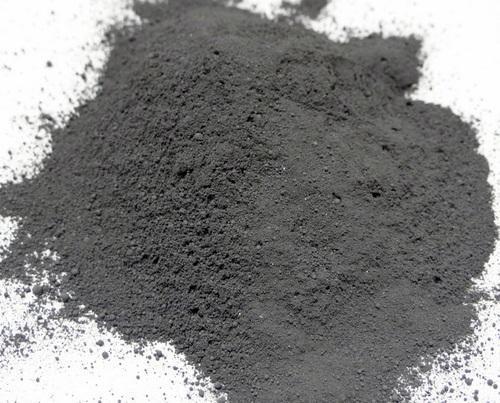
Fume Micro Silica
Price 10 INR / Kilograms
Minimum Order Quantity : 1 Ton
Dimensional Stability : Other, Excellent dimensional stability at high temperature
Specific Gravity : 2.2
Shape : Other, Amorphous, spherical particles
Chemical Composition : SiO2 > 90%, Al2O3 < 1.5%, Fe2O3 < 0.5%, CaO < 1.0%
Pozzolanic Micro Silica
Price 21 INR / Kilograms
Minimum Order Quantity : 10 Tons
Dimensional Stability : Other, High dimensional stability under various conditions.
Specific Gravity : 2.2.
Shape : Other, Fine powder.
Chemical Composition : Silicon dioxide (SiO2).
Micro Silica (Replacement Of Cement)
Price 14 INR / Bag
Minimum Order Quantity : 100 Bags
Dimensional Stability : Other, High stability under thermal and mechanical stress
Specific Gravity : Approx. 2.2
Shape : Powder
Chemical Composition : Silica (SiO2) > 85%

Contact Details

- Plot No 61, Nandanbaug Society, S. P. Ring Road, Behind Apple Woods, AT : Shela,Ahmedabad - 380058, Gujarat, India
- Phone : 08037736647
- Send Inquiry
GST : 24AARFK1787B1Z9
 Send Inquiry
- Mr. Krunal Patel (Plant Head)
- Mobile : 08037736647
|


 Send Inquiry
 Send SMS
K V METACHEM
All Rights Reserved.(Terms of Use)
Developed and Managed by Infocom Network Private Limited.
Developed and Managed by Infocom Network Private Limited.


 English
 Spanish
 French
 German
 Italian
 Chinese (Simplified)
 Japanese
 Korean
 Arabic
 Portuguese